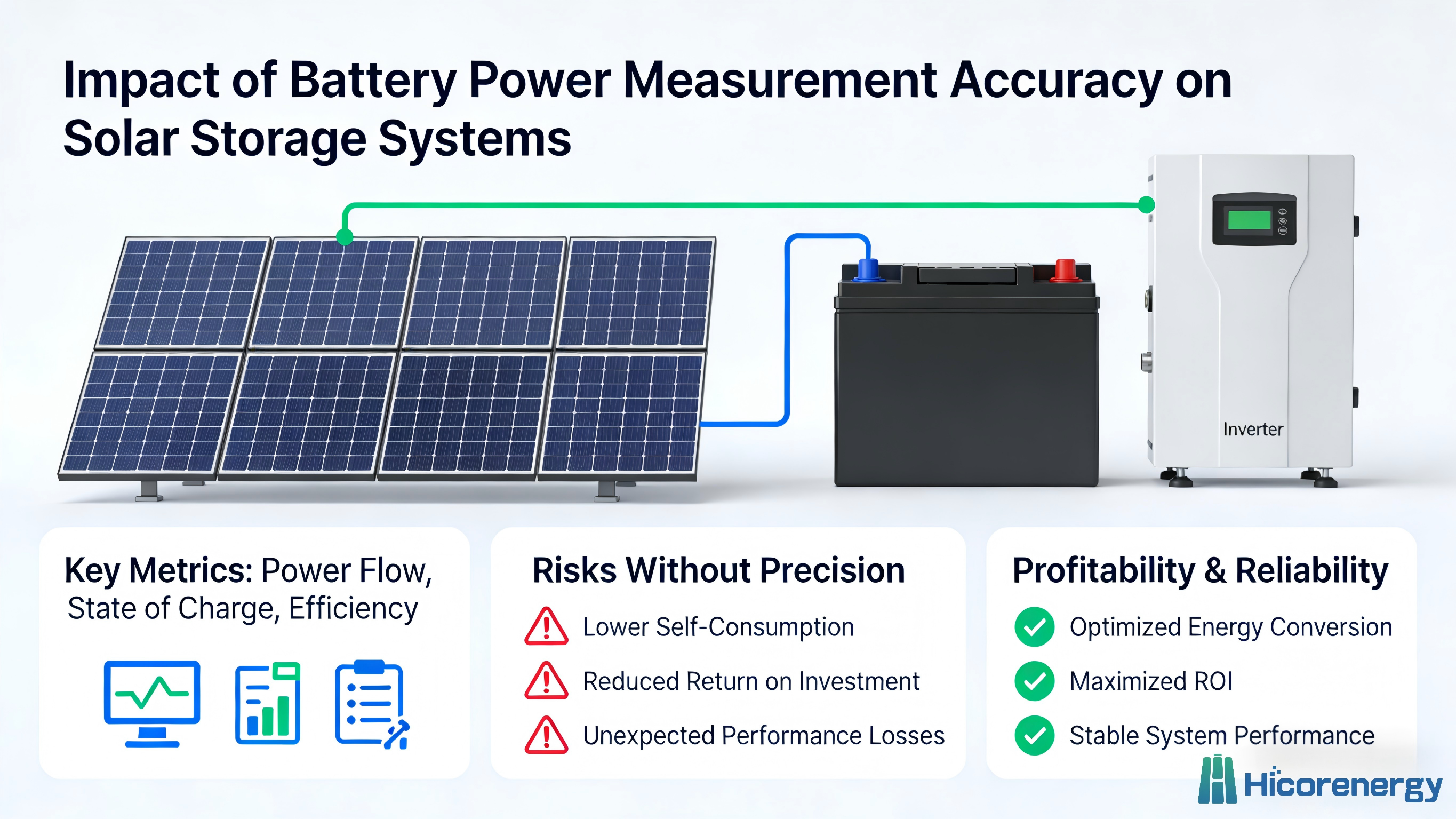
 Accurate battery power measurement determines how efficiently a solar storage system converts, stores, and delivers energy. Without precise monitoring of power flow, state of charge, and efficiency, system owners risk lower self-consumption, reduced return on investment, and unexpected performance losses. This article explains why measurement accuracy directly impacts solar storage profitability and reliability.
How Accurate Power Measurement Maximizes Solar Self-Consumption and ROI
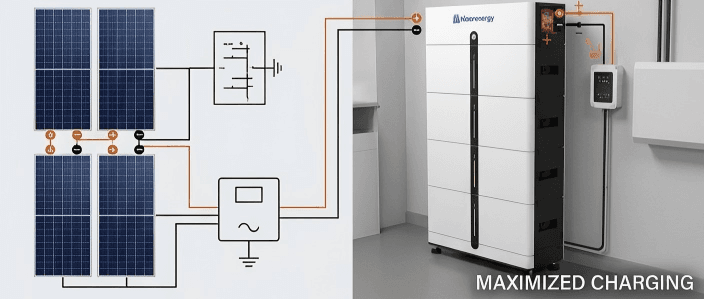
In a solar storage system, power measurement is not just a technical parameter—it is the foundation of economic performance. Accurate measurement ensures that energy produced by solar panels is either consumed instantly or stored efficiently instead of being exported unnecessarily to the grid at lower feed-in tariffs.
When power flow is precisely tracked, the battery management system (BMS) can intelligently prioritize charging during peak solar generation and discharging during high electricity price periods. Even a 3–5% measurement deviation can lead to miscalculated dispatch strategies, reducing annual savings.
For example, in residential systems with daily consumption of 25 kWh, a 4% measurement inaccuracy can translate into over 350 kWh of mismanaged energy annually. Over a 10-year lifecycle, that becomes a significant financial gap.
Accurate power measurement also prevents inverter overload and inefficient cycling, extending battery lifespan. The result is improved self-consumption rates, higher round-trip efficiency, and stronger long-term ROI.
Key Metrics to Monitor: State of Charge, State of Health, and Round-Trip Efficiency
Precise battery power measurement goes beyond simple voltage readings. Three metrics define system performance: State of Charge (SOC), State of Health (SOH), and round-trip efficiency. SOC determines available energy at any moment, SOH reflects long-term battery degradation, and round-trip efficiency measures how much stored energy can actually be reused. Monitoring these indicators together ensures optimized dispatch control, minimized degradation, and predictable storage performance—laying the groundwork for deeper analysis of monitoring tools and common mistakes.
Essential Tools for Solar Battery Monitoring: From BMS Data to IoT Platforms?
Modern solar storage systems rely on layered monitoring technologies. At the core is the Battery Management System (BMS), which continuously tracks voltage, current, temperature, and charge cycles. High-resolution current sensors with millisecond response times are critical for accurate power measurement and load tracking.
Advanced systems integrate smart meters and inverter-side monitoring to compare DC storage data with AC consumption patterns. This cross-verification reduces measurement drift and ensures accurate reporting of self-consumption ratios.
Cloud-based IoT platforms further enhance transparency. Real-time dashboards allow homeowners and commercial operators to visualize energy flow, identify anomalies, and optimize charge-discharge timing. Predictive analytics can forecast consumption trends and adjust system behavior automatically.
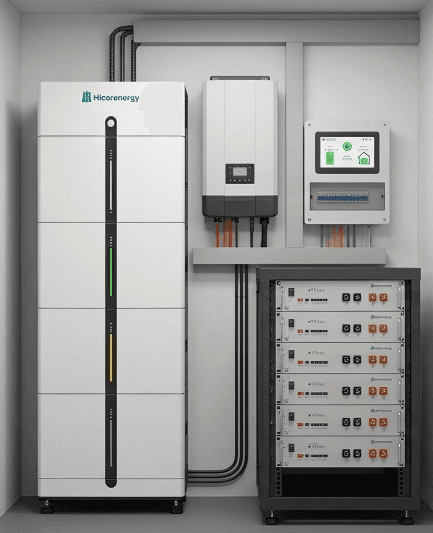
For instance, Hicorenergy’s SI LV1 residential energy storage solution incorporates a field-proven BMS with integrated DC breaker and intelligent monitoring. It delivers up to 14.08 kW continuous output and scalable capacity up to 30.72 kWh per stack. Combined with remote monitoring capabilities, it ensures precise measurement of power flow and operational status.
For commercial and industrial applications, the SI Station230 liquid-cooled system integrates advanced monitoring architecture with a 230 kWh configuration. Real-time tracking of grid interaction and load performance supports peak shaving and demand charge optimization. Accurate battery power measurement in such systems directly affects energy cost savings and system reliability.
Common Measurement Mistakes That Reduce Solar Storage Efficiency?
Despite technological advancements, several common mistakes reduce solar storage performance.
First, relying solely on inverter-reported data can create blind spots. Inverter readings may not capture internal battery losses accurately, leading to overestimated efficiency figures.
Second, improper calibration of current sensors results in cumulative errors. Even small deviations in current measurement can distort SOC calculations, causing premature cutoffs or over-discharging—both harmful to battery longevity.
Third, ignoring temperature compensation undermines accuracy. Battery voltage varies with temperature, and without correction algorithms, SOC readings become unreliable.
Fourth, neglecting periodic firmware updates in the BMS can prevent optimization improvements. Many modern systems refine measurement algorithms over time, and outdated software may reduce system efficiency.
Finally, misinterpreting round-trip efficiency is common. Some installers calculate efficiency based on DC-to-DC performance rather than full AC-to-AC cycles, leading to inflated expectations.
Avoiding these mistakes requires a comprehensive monitoring framework that integrates precise hardware sensors, intelligent BMS control, and cloud-based analytics.
Hicorenergy provides advanced lithium battery solutions including SI LV1, I-BOX 48100R, SI Station186, and SI Station230. With robust BMS architecture, scalable configurations, and intelligent monitoring systems, Hicorenergy supports optimized solar storage performance for residential and C&I applications worldwide.
For product details and partnership support:
Email: info@hicorpower.com
WhatsApp: +86 181-0666-3226