Choosing between solar panels series vs parallel depends on voltage targets, shading conditions, and battery compatibility. For lithium battery storage, correct array voltage improves charging efficiency, reduces cable loss, and protects system components. This guide explains how to calculate solar panel voltage for battery systems and choose the right solar charge controller.
Series vs Parallel Solar Panels: Key Differences in Voltage, Current, and Performance Under Shading
Understanding solar panels series vs parallel starts with voltage and current behavior.
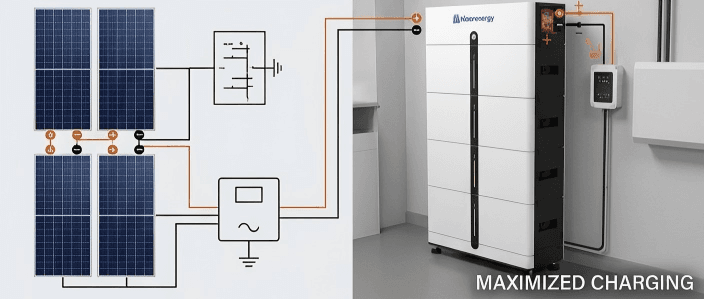
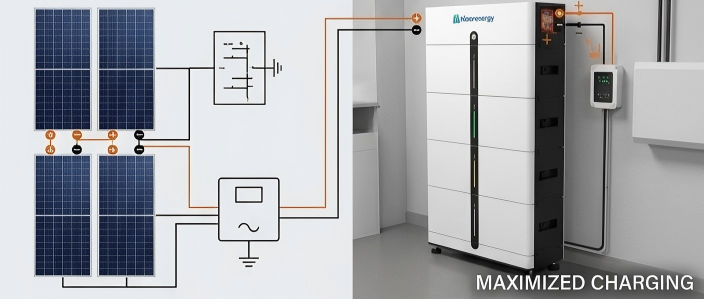
In a series connection, solar panel voltage adds together while current stays constant. For example, four 40V solar panels wired in series create a 160V array while maintaining the same current. This higher voltage reduces cable losses and improves efficiency for long wire runs and MPPT systems.
In parallel wiring, voltage stays constant while current increases. Four 40V solar panels in parallel still output 40V, but current quadruples. This setup is common in lower-voltage systems but requires thicker cables.
The biggest tradeoff is shading.
If one solar panel in a series string is shaded, total string output may drop significantly. In parallel systems, shaded panels impact only their own production.
| Wiring Type | Voltage | Current | Shading Impact | Best For |
|---|---|---|---|---|
| Series | Increases | Constant | Higher sensitivity | High-voltage arrays, MPPT |
| Parallel | Constant | Increases | Lower sensitivity | Small systems, PWM |
For lithium battery systems, series configurations are often preferred because higher voltage improves charging efficiency.
How to Calculate Your Solar Array Series Voltage for 12V, 24V, and 48V Lithium Batteries
Before choosing wiring, installers must understand how to calculate solar panel voltage for battery charging.
A lithium battery requires charging voltage above battery nominal voltage. Approximate charging ranges are:
-
12V lithium battery: 14.2V–14.6V
-
24V lithium battery: 28.4V–29.2V
-
48V lithium battery: 56V–58.4V
This means your solar panel array voltage must exceed these values after accounting for controller losses and weather conditions.
For example:
-
One 40V solar panel can charge a 24V lithium battery using MPPT
-
Two 40V panels in series (80V) are suitable for 48V lithium battery systems
-
Four panels in series can produce 160V for larger high-voltage arrays
Example Solar Array Voltage Chart
| Battery System | Minimum Charging Voltage | Recommended PV Array Voltage |
|---|---|---|
| 12V Lithium | 14.4V | 18V–40V |
| 24V Lithium | 28.8V | 40V–80V |
| 48V Lithium | 57.6V | 80V–150V |
Correct voltage sizing is essential not only for charging efficiency but also for selecting a compatible solar charge controller, which is covered below.
What Solar Charge Controller Works with Lithium Batteries? MPPT vs PWM for High-Voltage Arrays
Choosing the correct solar charge controller is just as important as deciding solar panels series vs parallel.
PWM controllers work by matching panel voltage close to battery voltage. They are affordable but inefficient for high-voltage solar panel arrays. For example, if an 80V array charges a 24V battery through PWM, excess voltage is wasted.
MPPT controllers solve this issue.
An MPPT solar charge controller converts excess voltage into usable current, improving charging efficiency by 20%–30% in many systems. This makes MPPT the preferred solution for lithium battery storage, especially when solar panels are wired in series.
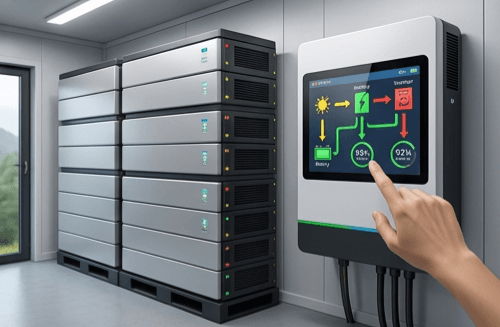
For residential backup and storage systems, Hicor Energy’s I-BOX 48100R is designed for compatibility with major inverter brands and advanced solar charging systems. With over 6000 cycles, >95% round-trip efficiency, and scalable storage architecture, it works effectively in solar + storage environments requiring optimized voltage management.
MPPT vs PWM Comparison
| Feature | PWM | MPPT |
|---|---|---|
| Best for low voltage | Yes | Yes |
| Best for series arrays | No | Yes |
| Efficiency | Lower | Higher |
| Lithium battery compatibility | Basic | Excellent |
For most modern lithium battery installations, MPPT is the better investment.
Cold Weather Voltage Spikes and Temperature Derating: NEC 690.7 and the 20% Safety Rule
Cold weather significantly impacts solar panel voltage.
As temperatures drop, open-circuit voltage (Voc) rises. This can push a solar array above inverter or controller voltage limits if not calculated properly.
NEC 690.7 requires installers to account for cold-weather voltage correction when designing arrays.
A common industry guideline is the 20% safety rule:
Maximum adjusted array voltage = panel Voc × number of panels × 1.2
Example:
-
Solar panel Voc = 50V
-
3 panels in series = 150V
-
Cold correction factor = 150V × 1.2 = 180V
If your solar charge controller max input is 150V, this design is unsafe.
This is why knowing how to calculate solar panel voltage for battery systems must include climate adjustments.
Hicor Energy’s SI LV1 energy storage system is suitable for residential installations requiring scalable backup with intelligent battery management. Its modular design supports 10.24kWh–30.72kWh per stack and simplifies integration with properly sized solar arrays and lithium battery systems.
Ignoring temperature derating can damage equipment, void warranties, and reduce long-term reliability.
Conclusion: Hicor Energy Solar Storage Solutions
Hicor Energy offers advanced lithium battery products including I-BOX 48100R, SI LV1, and scalable storage systems designed for solar panel integration, backup power, and efficient energy management worldwide.
Contact Guide
Email: info@hicorpower.com
WhatsApp: +86 181-0666-3226