A power outage can disrupt daily life, damage appliances, and create safety risks for homeowners and businesses. While portable generators have traditionally been the go-to backup solution, solar battery systems now offer a cleaner, quieter, and more cost-effective alternative. This article compares solar battery backup vs. generator systems, showing why solar + storage delivers better long-term value and stronger energy resilience.
The Runtime Reality Check: Why a Solar Battery Beats Fuel Limits in Prolonged Blackouts
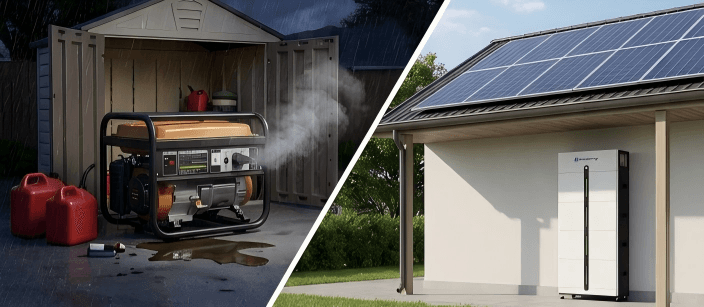
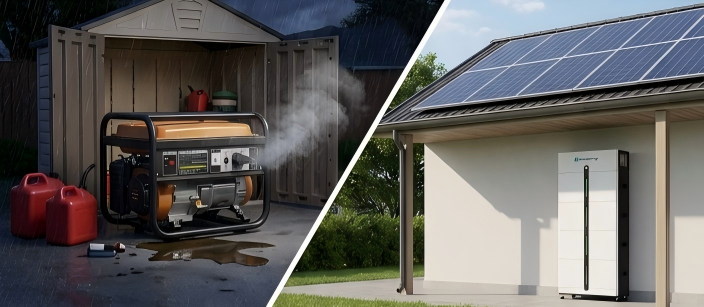
During a prolonged power outage, runtime is often the biggest weakness of a traditional generator. A diesel or gasoline portable generator can only operate as long as fuel is available. In many blackout scenarios caused by storms, grid failures, or natural disasters, fuel stations may close or experience shortages. This creates a major vulnerability for homeowners depending solely on generators.
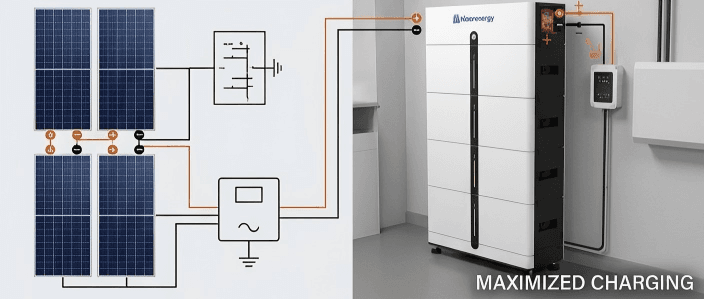
A home battery backup system works differently. Instead of relying on fuel deliveries, it stores electricity generated by solar panels or charged from the grid in advance. During a power outage, the battery discharges automatically to support critical household loads or even serve as a whole home backup battery.
For example, a 10kWh–20kWh solar battery paired with rooftop solar can recharge daily, extending backup duration indefinitely under sunny conditions. In contrast, a 5kW portable generator consuming approximately 0.75 gallons of fuel per hour may require over 18 gallons daily if operated continuously.
| Backup Solution | Daily Runtime Limit | Fuel/Charging Dependency | Recharging Method |
|---|---|---|---|
| Portable Generator | 8–24 hours depending on fuel tank | High | Manual refueling |
| Solar Generator + Battery | Multi-day or continuous | Low | Solar panels/grid charging |
This is why more homeowners are replacing traditional generators with solar storage systems before the next power outage.
True Cost Accounting: Lifetime Savings of Solar Battery Backup vs. Generator Fuel & Maintenance
At first glance, a generator appears cheaper. However, real cost analysis tells a different story.
A portable generator may cost $800–$3,000 upfront, but lifetime fuel costs, oil changes, spark plug replacement, filter maintenance, and engine repairs significantly increase total ownership expenses. Over 10 years, fuel alone can exceed the initial purchase cost, especially in regions with frequent power outage events.
A solar battery system requires a higher initial investment, but operating costs remain minimal. There is no fuel dependency, maintenance is low, and stored solar power can reduce daily electricity bills through peak shaving and self-consumption.
In short, generators solve emergencies temporarily. Solar batteries solve both daily energy costs and long-term outage protection. Keep reading to see why this operational advantage matters even more in residential settings.
Silent Running and Zero Fumes: The Residential Advantage of Solar Backup Power
Noise pollution is one of the most overlooked disadvantages of generators. Most portable generators operate between 60–80 dB, similar to a lawn mower or busy traffic. During an overnight power outage, this constant engine noise can disturb sleep, annoy neighbors, and violate local noise regulations.
Solar battery systems operate silently. There is no combustion engine, vibration, or exhaust. This makes them ideal for residential communities, apartments, villas, and home offices.
More importantly, generators emit carbon monoxide, nitrogen oxides, and particulate matter. Indoor misuse or poor ventilation can create life-threatening hazards. According to safety studies, generator-related carbon monoxide poisoning remains a recurring emergency risk during major power outage events.
A solar generator or battery storage system eliminates these concerns entirely. With zero fumes and zero emissions during operation, households benefit from cleaner indoor and outdoor air quality.
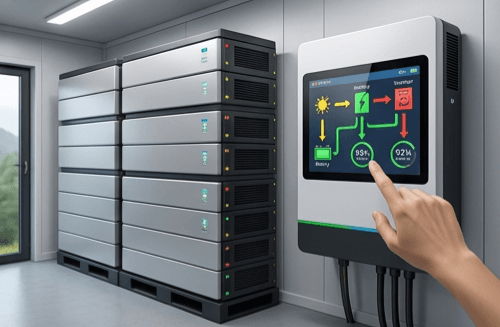
Hicor Energy addresses these residential needs with products like the SI LV1 stacked battery system, which supports up to 30.72kWh expansion for flexible whole home backup battery applications. Its plug-and-play modular design reduces installation time while offering strong safety performance with LiFePO4 chemistry and integrated battery protection.
For homeowners prioritizing quiet, safety, and comfort during a power outage, solar backup clearly offers the superior user experience.
Automatic Switchover and Daily Energy Savings: Why Solar + Storage Works Around the Clock
Generators are reactive devices. When a power outage occurs, users often need to manually start the system, connect loads, monitor fuel, and manage operation schedules.
A solar battery system is proactive.
With automatic transfer functionality, battery storage detects grid failure instantly and switches household loads within milliseconds. Refrigerators, lighting, Wi-Fi, medical equipment, and security systems continue running seamlessly during a power outage.
But the biggest advantage is that batteries deliver value every day, not just during emergencies.
A generator sits idle most of the year. In contrast, a home battery backup can:
-
Store excess solar production during the day
-
Discharge during evening peak pricing hours
-
Reduce electricity bills through time-of-use optimization
-
Improve solar self-consumption rates
For example, Hicor Energy’s I-BOX 48100R provides over 6000 cycles at 90% depth of discharge with >95% round-trip efficiency. This allows homeowners to use stored energy efficiently for both daily savings and emergency power outage protection.
Typical Daily Solar + Storage Energy Flow
| Time Period | Energy Source | Battery Action |
|---|---|---|
| Morning | Solar generation begins | Charging |
| Afternoon | Excess solar energy | Full charge |
| Evening peak hours | Battery discharge | Reduce grid usage |
| Night / Power outage | Battery backup | Supply loads |
This 24/7 utility is why solar + storage systems outperform generators economically and functionally.
Conclusion: Hicor Energy Solar Backup Solutions
Hicor Energy provides advanced lithium battery solutions including SI LV1, I-BOX 48100R, and commercial storage systems designed for reliable power outage protection, daily bill savings, and scalable whole home backup battery applications worldwide.
Contact Guide
Email: info@hicorpower.com
WhatsApp: +86 181-0666-3226