An Off-Grid Solar System allows homes and businesses to generate, store, and use electricity independently from the utility grid. By combining solar panels, Solar Battery storage, inverters, and backup solutions, users can achieve energy independence, reduce electricity bills, and maintain reliable power even during outages or in remote locations.
How Off-Grid Solar Systems Work Step by Step: From Sunlight to Electricity
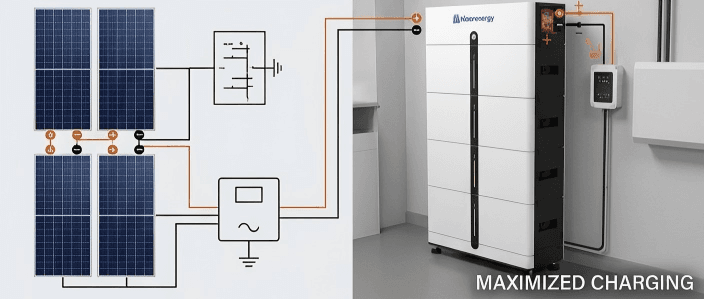
An Off-Grid Solar System captures sunlight through photovoltaic (PV) panels and converts solar radiation into direct current (DC) electricity. This electricity flows into a charge controller, which regulates voltage and current before safely charging the Solar Battery bank.
Stored energy in the battery is then converted by an inverter into alternating current (AC), making it usable for household appliances such as lights, refrigerators, air conditioners, and electronics. When solar production exceeds consumption, surplus energy is stored as Solar Energy Storage for nighttime or cloudy days.
A complete Off-Grid Solar System usually includes:
| Component | Function |
|---|---|
| Solar Panels | Generate electricity from sunlight |
| Charge Controller | Protects batteries from overcharging |
| Solar Battery | Stores excess solar power |
| Inverter | Converts DC to AC electricity |
| Backup Generator / Solar Generator | Emergency backup power |
Typical energy conversion efficiency data:
| Process | Efficiency |
|---|---|
| Solar Panel Conversion | 18%–23% |
| Battery Round-trip Efficiency | 90%–95% |
| Inverter Efficiency | 95%–98% |
Off-Grid Battery Storage Explained: Why Batteries Are the Heart of Your Standalone Power System
Without Off-Grid Battery Storage, an Off-Grid Solar System would only provide electricity when the sun shines. Batteries are the true foundation of off-grid living because they store daytime energy for night use, bad weather, and peak consumption periods.
Modern lithium Solar Battery systems outperform traditional lead-acid batteries by offering over 6000 life cycles, deeper discharge rates, and minimal maintenance. Choosing the right battery directly determines your system reliability, backup duration, and long-term investment return. Keep reading to understand how to properly size your battery system and compare off-grid solutions.
How to Size an Off-Grid Solar System: Calculate Your Energy Needs, Battery Bank, and Solar Array
Sizing an Off-Grid Solar System begins with understanding your daily electricity consumption.
Step 1: Calculate Daily Energy Use
Add the wattage of all appliances multiplied by hours used per day.
Example:
| Appliance | Watts | Hours/Day | Daily Usage |
|---|---|---|---|
| Refrigerator | 150W | 24h | 3600Wh |
| TV | 100W | 5h | 500Wh |
| Lights | 80W | 6h | 480Wh |
| Laptop | 60W | 8h | 480Wh |
Total = 5060Wh/day (5.06kWh/day)
Step 2: Determine Battery Capacity
For 2 days autonomy:
Battery needed = 5.06kWh × 2 = 10.12kWh
Recommended lithium battery bank: 10–12kWh.
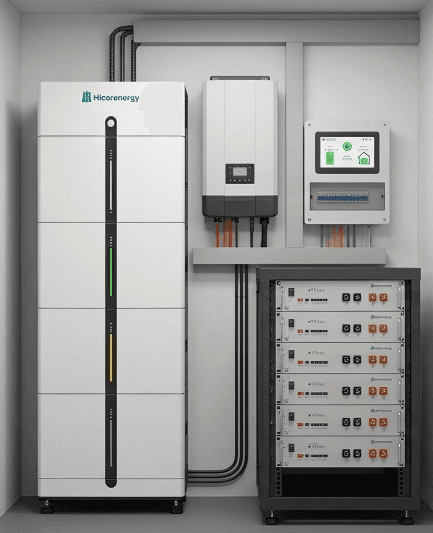
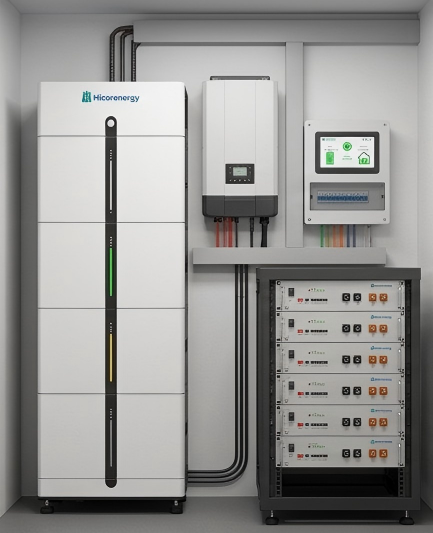
For example, Hicorenergy’s SI LV1 modular lithium battery system supports flexible expansion from 10.24kWh to 30.72kWh, making it ideal for residential Off-Grid Battery Storage. It uses LiFePO4 chemistry, supports plug-and-play installation, and offers more than 6000 cycles.
Step 3: Size Solar Array
Assuming 5 peak sunlight hours:
Solar array = 5060Wh ÷ 5h = 1012W
Considering system losses, install 1.3–1.5kW solar panels minimum.
This calculation ensures your Off-Grid Solar System can meet demand consistently while maintaining healthy battery reserves.
Off-Grid vs Grid-Tied Solar: Which System Is Better for Your Home and Lifestyle?
Choosing between grid-tied and Off-Grid Solar System depends on your location, energy goals, and grid reliability.
Off-Grid Solar System Advantages
-
Full energy independence
-
No utility bills
-
Reliable backup during blackouts
-
Ideal for remote homes, farms, cabins, telecom stations
Off-Grid Solar System Challenges
-
Higher upfront investment
-
Requires battery sizing and maintenance planning
-
Backup generation recommended
Grid-Tied Solar Advantages
-
Lower initial cost
-
Net metering opportunities
-
No large battery bank required
Grid-Tied Limitations
-
Grid outages may still shut down system
-
Dependence on utility company policies
Comparison table:
| Feature | Off-Grid Solar System | Grid-Tied Solar |
|---|---|---|
| Utility Dependence | None | Required |
| Battery Required | Yes | Optional |
| Backup During Outage | Yes | Usually No |
| Upfront Cost | Higher | Lower |
| Best For | Remote/unstable grids | Urban stable grids |
For customers in Africa, Southeast Asia, and regions with unstable electricity supply, an Off-Grid Solar System is often more practical.
Hicorenergy’s I-BOX 48100R residential battery offers 5.12kWh capacity, >95% round-trip efficiency, and compatibility with most inverter brands. For larger commercial projects, products such as SHV48100 and SI Station 230 provide scalable Solar Energy Storage solutions for factories, buildings, and industrial backup power.
Why More People Are Choosing Off-Grid Living with Solar Energy Storage
Rising electricity costs, unstable grids, and sustainability concerns are driving more households toward Off-Grid Solar System adoption.
Global off-grid solar market growth:
| Year | Market Size |
|---|---|
| 2023 | $2.1 Billion |
| 2025 | $3.4 Billion |
| 2030 Forecast | $6.8 Billion |
Key reasons users switch:
-
Energy security
-
Lower long-term operating costs
-
Carbon reduction
-
Remote accessibility
A properly designed Off-Grid Solar System paired with efficient Solar Battery technology can deliver 10–20 years of reliable service.
Conclusion
Hicorenergy provides advanced Off-Grid Solar System, Solar Battery, and Solar Energy Storage solutions including SI LV1, I-BOX 48100R, SHV48100, and SI Station series for residential and commercial users worldwide.
Contact Us
Email: info@hicorpower.com
WhatsApp: +86 181-0666-3226