 Battery energy storage efficiency has become a decisive factor in the global energy transition. As lithium-ion, lead-acid, sodium-ion, and emerging technologies compete for market share, efficiency, scalability, and real-world performance will determine long-term winners. This article compares mainstream battery technologies, explores future breakthroughs, and explains how system-level design ultimately defines usable efficiency.
1.Efficiency Showdown: A Complete Data Comparison of Lithium-ion, Lead-acid & Sodium-ion Batteries
From a data perspective, lithium-ion batteries currently lead the market in round-trip efficiency, typically exceeding 90–95%, with LiFePO₄ chemistry offering an optimal balance between safety, cycle life, and performance. Their high energy density and low self-discharge make them suitable for both residential and commercial energy storage systems. Lead-acid batteries, while cost-effective upfront, generally deliver only 70–85% efficiency, suffer from limited cycle life, and experience rapid degradation under deep discharge conditions. Sodium-ion batteries are emerging as a potential alternative, with efficiency levels approaching 85–90% and advantages in raw material availability. However, they still lag behind lithium-ion systems in energy density, commercial maturity, and large-scale deployment. In real-world applications, lithium-ion remains the most efficient and reliable choice when lifetime energy output and total cost of ownership are considered.
2.EV to Grid: The Scalability Challenge of Using Power Batteries for Energy Storage
As electric vehicle adoption accelerates, repurposing EV batteries for grid and stationary storage has gained attention. However, scalability presents significant challenges. Power batteries are designed for mobility, not continuous charge-discharge cycles or long-duration stationary operation. Variations in battery health, inconsistent degradation rates, and complex integration requirements reduce overall system efficiency. Grid-scale and residential energy storage demand standardized modules, predictable performance, and seamless integration with inverters and monitoring platforms. These limitations explain why purpose-built energy storage systems continue to outperform second-life EV batteries in terms of efficiency, safety, and long-term reliability, making dedicated storage solutions more viable for scalable deployment.
3.Rising Stars for Long-Duration Storage: Breakthroughs in Flow & Solid-State Batteries
Beyond conventional chemistries, flow batteries and solid-state batteries are gaining attention as potential solutions for long-duration energy storage. Flow batteries excel in scalability and long cycle life, often exceeding 10,000 cycles with minimal degradation, making them attractive for utility-scale applications. Their main limitation lies in lower energy density and higher system complexity, which constrain adoption in space-limited environments. Solid-state batteries, meanwhile, promise higher energy density, improved safety, and potentially greater efficiency by replacing liquid electrolytes with solid materials. While laboratory results are promising, large-scale commercialization remains limited due to manufacturing challenges and cost barriers. In the medium term, these technologies are expected to complement rather than replace lithium-ion systems, particularly in niche applications requiring extended discharge durations or enhanced safety profiles.
4.System Integration Keys: How BMS, Thermal Management & Safety Define Real-World Efficiency
Battery efficiency is not determined by cell chemistry alone. In real-world systems, the battery management system (BMS), thermal management, and safety architecture play a critical role in maintaining optimal performance. Advanced BMS platforms ensure precise state-of-charge control, cell balancing, and fault detection, directly improving usable energy output and extending cycle life. Effective thermal management keeps batteries within optimal temperature ranges, preventing efficiency losses and premature aging. Safety mechanisms, including multi-layer hardware and software protection, reduce operational risks and downtime. Well-integrated systems consistently deliver higher real-world efficiency than poorly managed installations, even when using similar battery cells.
5.Hicorenergy Energy Storage Solutions
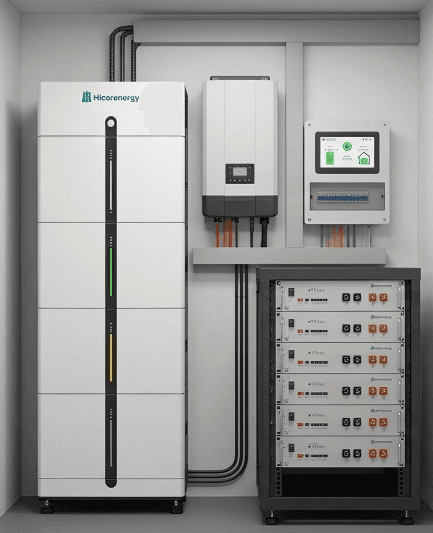
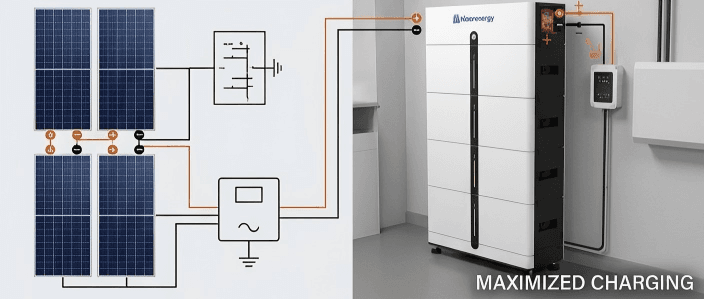
Hicorenergy provides residential and commercial energy storage systems built on high-efficiency LiFePO₄ technology, combining long cycle life, advanced BMS, and robust thermal design. Its solutions are engineered for safety, scalability, and reliable performance across diverse application scenarios.
Contact Hicorenergy to explore your next energy storage project:
Email: info@hicorpower.com
WhatsApp: +86 181-0666-3226