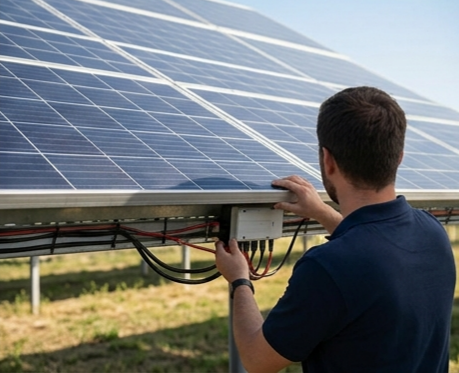
Series wiring solar panels can significantly improve voltage efficiency for home battery storage systems, but it also introduces challenges such as shading sensitivity and system imbalance. Understanding the pros and cons of solar panels series configurations helps homeowners optimize performance, reduce losses, and ensure reliable energy storage in real-world conditions.
How Series Wiring Boosts Voltage for Efficient Home Battery Charging
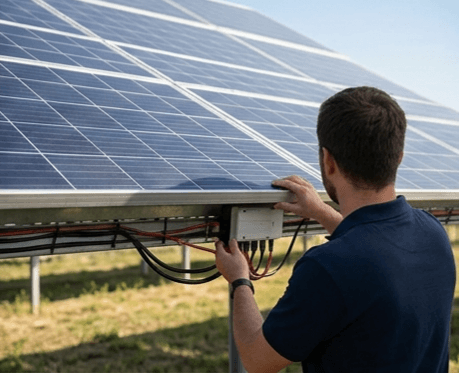
In a solar panels series configuration, the voltage of each panel adds up while the current remains constant. This higher voltage output is particularly beneficial for home battery storage systems, as it reduces energy loss during transmission and improves inverter efficiency. Series wiring solar panels enables faster and more stable charging, especially when paired with modern lithium battery systems that operate within higher voltage ranges.
One of the main solar panel series connection advantages is reduced wiring loss, which becomes critical in residential systems with longer cable runs. Higher voltage also allows for smaller cable sizes, reducing installation costs. However, the system’s overall performance is limited by the weakest panel in the string. Therefore, while series wiring solar panels enhances efficiency, it requires careful design and panel matching to ensure consistent energy output for home battery storage.
The Shading Problem: Why One Shaded Panel Can Disrupt Your Entire Solar String
Despite the efficiency benefits, solar panel shading is a major concern in series wiring solar panels setups. When one panel is shaded, the entire string’s performance drops, reducing energy generation and affecting home battery storage efficiency. This challenge highlights the importance of understanding both advantages and limitations before choosing a system design, encouraging a deeper look into alternative configurations and practical applications.
Series vs. Parallel for Home Battery Systems: Key Differences Every Homeowner Should Know
When comparing solar panels series and parallel configurations, the key difference lies in how voltage and current behave. In series wiring solar panels, voltage increases while current stays constant, making it ideal for efficient energy transfer to home battery storage systems. In parallel systems, current increases while voltage remains stable, offering better resilience against solar panel shading since each panel operates independently.
For homeowners, this distinction directly impacts system reliability and performance. Series wiring solar panels are typically more efficient in controlled environments with minimal shading, while parallel systems provide greater flexibility in complex installations. However, parallel wiring often requires thicker cables and may result in higher energy losses over distance.
Advanced home battery storage solutions, such as Hicorenergy’s I-BOX 48100R, are designed to work efficiently with various configurations. With high compatibility across inverters and strong battery management systems, such products help mitigate performance fluctuations caused by inconsistent solar input. Ultimately, choosing between series and parallel depends on site conditions, energy goals, and long-term system scalability.
When Series Wiring Makes Sense for Your Solar + Battery Storage System
Series wiring solar panels is most effective in installations where shading is minimal and consistent sunlight is available throughout the day. In such environments, the solar panel series connection advantages—such as higher voltage efficiency and reduced transmission loss—can be fully realized. This makes series configurations particularly suitable for residential rooftops with uniform orientation and limited obstructions.
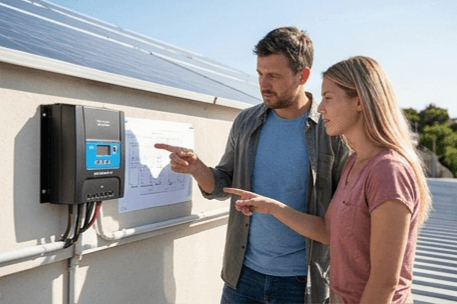
Additionally, systems focused on maximizing charging efficiency for home battery storage benefit from higher voltage inputs. Products like Hicorenergy’s SI LV1, with its scalable modular design and strong output capability, pair well with series-configured solar arrays by efficiently storing and delivering energy for backup power, peak usage, and daily consumption optimization.
However, proper system design remains critical. Incorporating technologies such as bypass diodes or module-level optimizers can help mitigate the impact of solar panel shading. By carefully evaluating environmental conditions and energy requirements, homeowners can determine whether series wiring solar panels is the optimal solution for their solar + storage system.
Hicorenergy offers advanced lithium battery solutions like SI LV1 and I-BOX 48100R, delivering reliable, scalable, and efficient home battery storage. With strong compatibility, long cycle life, and intelligent monitoring, these systems support optimized solar energy utilization in various residential applications.
For more information, please contact:
Email: info@hicorpower.com
WhatsApp: +86 181-0666-3226