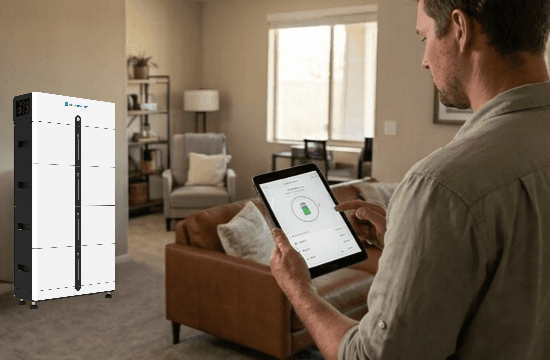
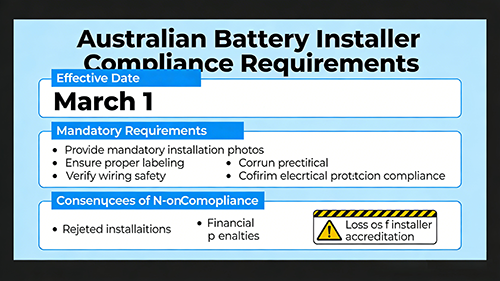
Australian battery installers must comply with stricter documentation and installation requirements starting March 1. Installers will need to provide mandatory installation photos, ensure proper labeling, verify wiring safety, and confirm electrical protection compliance. Failure to meet these requirements may lead to rejected installations, financial penalties, or loss of installer accreditation.
A Tightening Regulatory Environment
Australia’s distributed energy storage market continues to expand rapidly, driven by residential solar adoption and increasing demand for backup power. As installations grow, regulators are tightening compliance requirements to ensure system safety and reliability. For Battery Installers, these new measures are designed to improve transparency and reduce the risk of unsafe or poorly documented installations.
From March 1, installers must provide more detailed documentation during system commissioning. Regulators and industry bodies are emphasizing traceability, installation quality, and clear evidence that systems meet technical standards. These changes signal a broader effort to professionalize the installation sector and protect both installers and end users.
The Core of the New Regulations: Mandatory Photo Requirements
The most significant change is the mandatory photo documentation requirement. Under the updated compliance process, Battery Installers must upload clear installation photographs as part of the system verification process. These images typically include battery placement, wiring connections, labeling, safety devices, and the surrounding installation environment.
The goal of these requirements is to create a verifiable installation record. Regulators and energy authorities can review the photos to confirm that systems meet safety and technical standards without needing on-site inspections. However, incomplete or unclear documentation can lead to installation rejection.
This change also encourages installers to follow best practices more carefully. Proper labeling, organized wiring, and clearly visible protection devices are now essential not only for safety but also for passing compliance reviews.
In-Depth Analysis: The Three Most Common Compliance Issues
Despite increasing regulatory oversight, many installations still fail compliance checks. Industry data shows that most problems are not related to complex technical failures but rather to basic installation details.
For Battery Installers, three issues account for the majority of compliance failures: labeling errors, wiring problems, and inadequate electrical protection. Understanding these common mistakes can help installers avoid costly rework and ensure smooth approval during the verification process.
Issue 1: Labeling Issues (62.8% of Non-Compliant Installations)
Labeling problems are the most frequent cause of “non-compliant” installations, accounting for 62.8% of cases. In many situations, systems are technically functional but fail compliance because warning labels, identification tags, or safety markings are missing, damaged, or placed incorrectly.
Proper labeling serves several purposes. First, it provides clear safety information to electricians, emergency responders, and maintenance personnel. Second, it helps regulators quickly verify system configuration during inspections or documentation reviews.
For example, battery systems must include clear labels indicating battery type, voltage level, isolation points, and shutdown procedures. If these labels are not visible in installation photos, the system may be flagged as non-compliant.
To avoid this issue, Battery Installers should implement a standardized labeling checklist before submitting installation documentation. Taking clear photos that show all labels can significantly reduce the risk of rejection.
Issue 2: Wiring Issues (0.9% of Unsafe Installations)
Although wiring issues represent only 0.9% of cases, they are the leading cause of installations classified as “unsafe.” Improper cable routing, loose connections, or inadequate insulation can create serious safety risks.
In battery energy storage systems, wiring must handle high current levels and operate reliably over long periods. Poor wiring practices can lead to overheating, electrical faults, or even fire hazards. As a result, regulators take these violations very seriously.
For Battery Installers, compliance requires ensuring that cables are correctly sized, securely connected, and properly protected. Wiring should be neatly organized and supported to prevent mechanical stress. In addition, installers should verify that isolation switches and connectors are correctly installed.
Clear photo documentation showing cable routing and connection points is also essential. These images help regulators confirm that wiring complies with technical standards.
Issue 3: Electrical Protection Issues (Classified as “Non-Compliant” Installations)
Electrical protection devices play a crucial role in ensuring system safety. However, many installations are classified as non-compliant because protection components are missing, incorrectly installed, or poorly documented.
Common issues include improperly rated circuit breakers, missing fuses, or unclear isolation points. Without proper protection, battery systems may not shut down safely during faults or maintenance operations.
For Battery Installers, verifying protection devices should be a standard part of the installation process. Each battery system should include correctly rated breakers, isolation switches, and protective components that match system specifications.
Additionally, protection devices must be visible in installation photos. Clear documentation helps reviewers confirm that the system can safely handle electrical faults and operational risks.
Severe Consequences: The Price of Violating Regulations
Failure to comply with the new requirements can result in significant consequences for Battery Installers. Non-compliant installations may be rejected during documentation review, forcing installers to revisit the site and correct the issues.
This can lead to additional labor costs, project delays, and dissatisfied customers. In more serious cases, repeated violations could result in suspension from certification programs or restrictions on participating in government incentive schemes.
Given the growing importance of compliance in the energy storage industry, installers must treat regulatory requirements as an integral part of their workflow.
Expert Recommendations for Installers
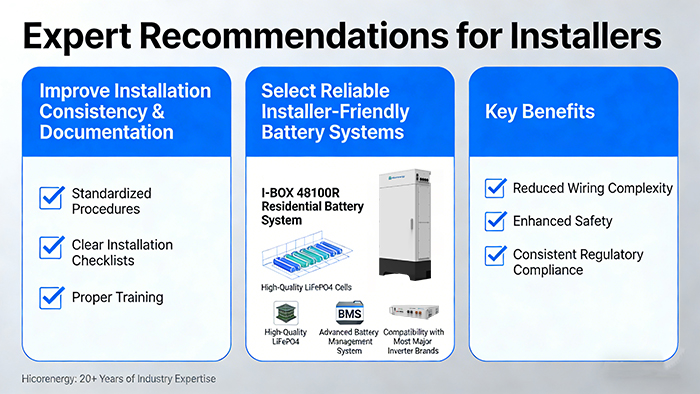
To adapt to the new regulatory environment, Battery Installers should focus on improving installation consistency and documentation practices. Standardized procedures, clear installation checklists, and proper training can help teams reduce compliance risks.
Selecting reliable and installer-friendly battery systems also plays an important role. Products developed by Hicorenergy, for example, are designed with safety, compatibility, and ease of installation in mind. According to company information, Hicorenergy provides lithium battery energy storage solutions developed by an experienced industry team with over 20 years of expertise.
Solutions such as the I-BOX 48100R residential battery system feature high-quality LiFePO4 cells, advanced battery management systems, and compatibility with most major inverter brands. These design features simplify installation and improve system reliability.
Installer-friendly systems can reduce wiring complexity, improve safety, and help ensure that installations meet regulatory requirements more consistently.
Conclusion
For Battery Installers, the March 1 regulations emphasize documentation, safety, and compliance. Using reliable systems such as Hicorenergy battery solutions can help simplify installation, reduce errors, and improve regulatory approval success.
Contact:
Email: info@hicorpower.com
WhatsApp: +86 181-0666-3226